SHOT BLASTING
What is Shot Blasting?
Shot blasting is the mechanical process in which abrasive substances are accelerated at a high velocity, directed towards a surface to remove contamination; as to create a uniform surface condition though an easy repeatable process.
Shot blasting is a useful process for the removal of contaminants such as rust & oxidation, or biproducts of manufacturing process such as mill scale. Shot blasting can also be used to removes coatings and paint residues. Unlike manual cleaning or processes involving chemicals, shot blasting provides full surface coverage and consistent results across batches, making it the preferred cleaning method for industrial environments.
Why Surface Preparation Matters More Than Coating
Common Failures Without Proper Blasting
Adhesion Failure
Subsurface Corrosion
Coating Inconsistency
Reduced Lifespan
Surface Cleanliness Standards
SA 1 - Light Blasting Cleaning
Only loose contamination is removed. Mill scale and rust may remain. Rarely suitable for coating applications.
SA 2 - Thorough Blast Clean
Most contamination is removed, but slight residue may remain. Used where lower performance requirements are acceptable.
SA 2.5 - Near White Metal (Industry Standard)
This is the most commonly specified standard, with almost all rust and mill scale removed and minimal staining. This standard is required for most industrial coating systems.
SA 3 -White Metal
This standard is for completely clean surfaces, requiring no visible contamination and the highest level preparation. This standard is often used for offshore or high corrosion environments
Surface Profile
What Controls Surface Profile?
Abrasive Media Type
Media Size
Blasting Velocity
Angle of Impact
Exposure Time
Why Surface Profile Matters
A correct surface profile increases coating adhesion, improves durability and corrosion resistance, and ensures consistent coating thickness. Getting the surface profile right is of the utmost importance; if the surface is too smooth, coatings struggle to bond, leading to early failures, whereas if the the surface is to rough, the thickness of the coating can be uneven, which can lead to weak points developing.
Abrasive Media Types
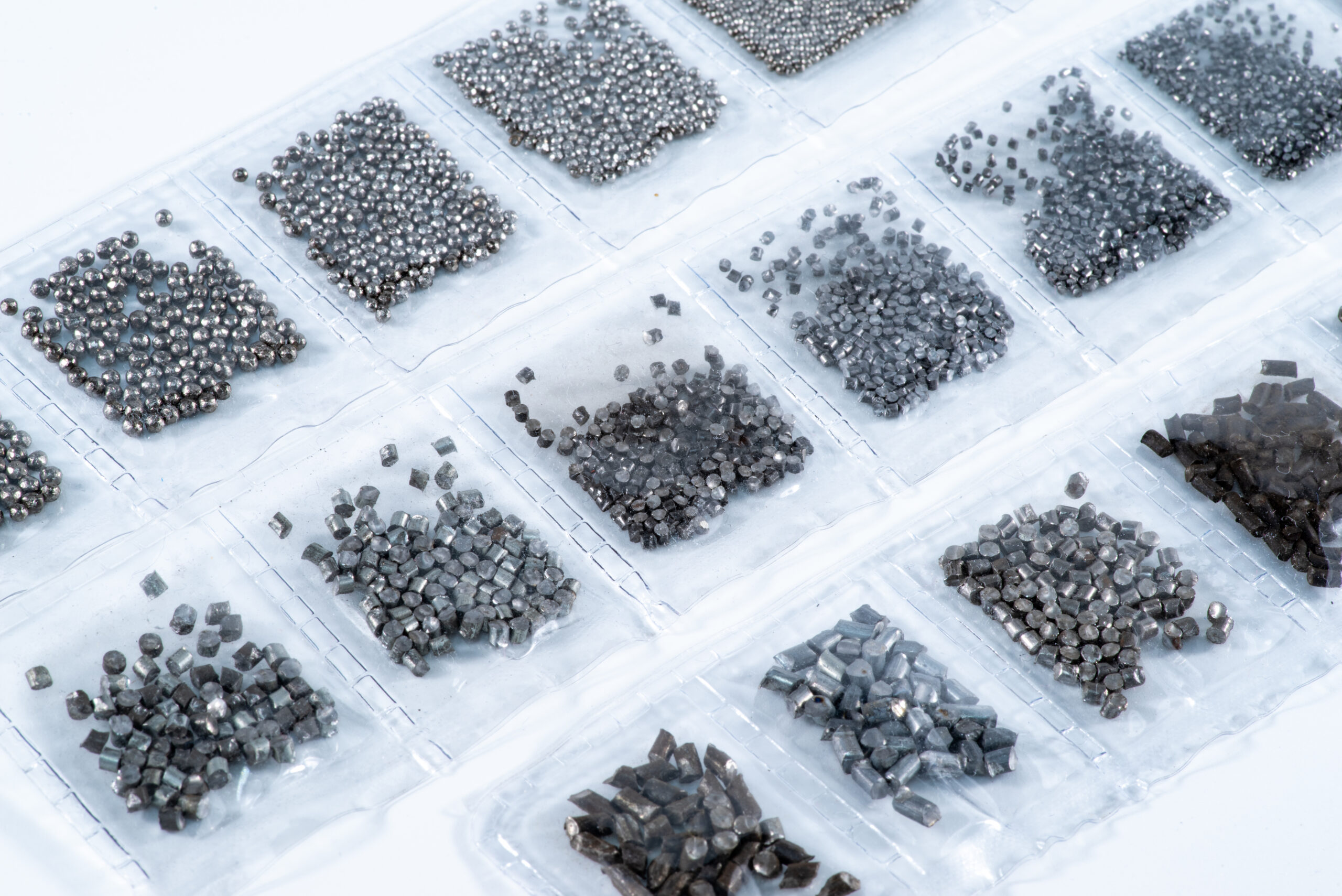
Steel Shot (Peening Action)
Steel shot, spherical in shape, creates a peening effect as opposed to cutting. This effect creates a smoother, more uniform finish that reduces sharp peaks in the surface profile. Steel shot is often used in applications where a smoother finish is required, or when components must retain dimensional integrity.
Steel Grit (Cutting Action)
Steel grit is angular in nature, creating an aggressive cutting action; capable of removing heavy contamination quickly, whilst leaving a deeper and sharper surface profile. Steel grit is typically used for heavy rust, mill scale removal and structural stell preparation.
Mixed Media
In many industrial applications, a blend of shot and grit is used. This combines cutting and peening actions to balance cleaning speed with surface finish, creating an optimised profile for coating systems.
Media Size
Large Media
- more aggressive impact
- deeper surface profile
- faster removal of heavy contamination
Smaller Media
- finer finish
- shallower profile
- better for precision components
Blasting Parameters
Velocity
- higher velocity = more aggressive cleaning
- lower velocity = more controlled finish
Impact Angle
- direct angle = maximum cleaning
- angled impact = more controlled profile
Exposure Time
- too short → incomplete cleaning
- too long → over-processing
Media Flow Rate
- affects consistency
- affects efficiency
Shot Blasting Systems
Wheel Blasting Systems
Wheel blasting uses turbines to accelerate abrasive media. This gives the system extremely high throughput with consistent and repeatable results. Wheel Blasting is ideal for large volume applications, like fabrication workshops, production lines and inn the forging of structural steel.
Air Blasting Systems
Air blasting uses compressed air to propel media. This system gives the manufacturer precise control of the process, making it flexible for a variety of different parts and suitable for components with complex geometries. Air blasting systems are often used in specialist cleaning and in varied batch productions.
Manual Blasting
Manual blasting is commonly used where flexibility is required. Manual blasting is very adaptable and suited for irregular parts, but it is limited by operator dependency and is often a less consistent process
Automated Blasting Systems
Automated systems are designed for continuous processing. They can be high in consistency, can reduce labour and generate easily repeatable results.
Full Shot Blasting Process
Loading
Blasting
Media Separation
Dust Extraction
Inspection
Post Blasting Cleaning
The Essential Nature of Post Blast Cleaning
Common Cleaning Methods
Spray Washer Systems
Industrial Parts Washers
Application Specific Cleaning
Integrating Shot Blasting
Shot blasting shouldn’t be treated as a standalone process. It should be part of a complete preparation system. When integrated correctly, consistency improves, throughput increases and the amount of failures reduce.
The most common errors made when establishing a shot blasting system are selecting the wrong media, prioritising speed over consistency and skipping the post blasting clean. These mistakes often result in higher costs and reduced quality, often leading to an increase in the frequency of rework.
Industry Applications
Steel & Construction
Shot blasting is the standard in structural steel fabrication.
Steel often requires blasting as it supplied with mill scale.
Steel must be SA 2.5 minimum.
Structural Steel is used a all major construction.
Energy Sector
The energy sector has some of the highest standards for surface preparation.
Blasted materials are often exposed to chemical or atmospheric corrosion
Materials must be minimum of SA 2.5 or SA 3
These materials are often used in pipelines and offshore structures.
Automotive & Engineering
Shot blasting is used in engineering for both preparation & finishing.
Engineering often involves precision components and high production volumes
Fabrication & Manufacturing
Fabricators rely on shot blasting for consistent preparation before coating. They often require flexibility and they handles a wide variety of materials, in parts of many different sizes.
Maintenance
Shot blasting is widely used to restore used or corroded equipment. This varies from tanks and structural components to industrial machinery, removing corrosion and extending the lifespan of these machines.
Shot Blasting for Specific Problems
Rust Removal
Rust contamination can spread further than just the surface.
Shot blasting removes the contamination, preventing the spread to beneath the coating.
Mill Scale Removal
Mill scale form during hot rolling and can prevent proper adhesion of coatings, as well as trap moisture.
Shot blasting can completely remove mill scale and expose the clean substrate.
Coating Removal
Shot blasting can be used to remove paint, powder coating and other types of protective layers.
This is critical for the refurbishment process and re-preparing the surface.
Cost vs Performance
Contract Shot Blasting

Renting Equipment

Buying Equipment

FAQs
- What is shot blasting and how does it work?
Shot blasting is a mechanical surface preparation process where abrasive media is propelled at high velocity onto a surface. This removes contamination such as rust, scale and coatings while also creating a controlled surface profile. This profile is critical for coating adhesion, ensuring paints and protective systems bond correctly to the substrate.
- Why is shot blasting important in industrial processes?
Shot blasting is essential because it determines the condition of the surface before coating or finishing. Without proper preparation, coatings fail prematurely, corrosion develops beneath the surface, and overall product lifespan is reduced. It is one of the most critical stages in any finishing process.
- Can shot blasting remove rust completely?
Yes, shot blasting can remove rust back to clean base metal when correctly specified. This prevents corrosion from continuing beneath coatings and ensures long-term protection. Partial rust removal is not sufficient, as any remaining corrosion will continue to degrade the material.
- Can shot blasting remove paint and coatings?
Yes, shot blasting is highly effective at removing most industrial coatings, including paints and powder coatings. The effectiveness depends on the coating thickness, type and the abrasive media used, but it is widely used for refurbishment and reprocessing applications.
- Is shot blasting required before painting or powder coating?
In most industrial applications, yes. Shot blasting creates the surface profile required for coatings to bond properly. Without it, coatings are applied onto unstable surfaces, leading to adhesion failure and reduced durability.
- What is SA 2.5 in shot blasting?
SA 2.5 is a near-white metal cleaning standard where almost all contamination is removed. It is commonly specified before coating because it provides a clean and uniform surface that coatings can adhere to effectively.
- What is SA 3 and when is it used?
SA 3 is a white metal standard where all visible contamination is removed. It is used in critical environments such as offshore or high-corrosion applications where maximum protection is required.
- What is surface profile in shot blasting?
Surface profile refers to the microscopic roughness created during blasting. This allows coatings to mechanically bond to the surface, improving adhesion and durability.
- How is surface profile measured?
Surface profile is typically measured using replica tape or specialised gauges. These tools ensure the profile meets the requirements of the coating system being applied.
- What happens if the surface profile is incorrect?
If the profile is too smooth, coatings cannot adhere properly. If it is too rough, coatings may not cover evenly, leading to weak points. Both scenarios can result in premature coating failure.
- What is wheel blasting?
Wheel blasting uses turbine-driven systems to propel abrasive media at high speed. It is ideal for high-volume applications where consistency and throughput are critical.
- What is air blasting?
Air blasting uses compressed air to direct abrasive media onto a surface. It offers more control and is suitable for complex or delicate components.
- What media is used in shot blasting?
Common media includes steel shot, steel grit and mixed abrasives. The choice depends on the required finish, surface profile and level of contamination.
- Can shot blasting be controlled precisely?
Yes, parameters such as pressure, media type, size and exposure time can all be adjusted to achieve the desired result.
- Can delicate components be blasted?
Yes, when the correct media and parameters are used, even delicate components can be processed without damage.
- Do parts need cleaning after shot blasting?
In many cases, yes. Blasting removes major contamination, but fine dust and residues may remain and should be removed before coating.
- Is degreasing required after blasting?
Often yes, particularly where oils or residues are present. Industrial washing systems are commonly used to ensure the surface is fully clean before coating.
https://degreasingmachines.com/industrial-parts-washers-the-complete-guide/
- Can parts be washed after blasting?
Yes, spray washing systems are frequently used after blasting to remove fine particles and contaminants.
https://degreasingmachines.com/spray-washing/
- What happens if post-blast cleaning is skipped?
Skipping cleaning can leave dust and residues on the surface, which can be trapped under coatings. This reduces adhesion and increases the risk of coating failure.
- How soon should parts be coated after blasting?
Ideally immediately. If left exposed, surfaces can begin to oxidise (flash rust), which reduces coating performance.
- What industries use shot blasting?
Shot blasting is used across structural steel, oil & gas, automotive, manufacturing and general engineering industries.
- Can structural steel be shot blasted?
Yes, it is one of the most common applications, particularly before painting or galvanising.
- Can castings be shot blasted?
Yes, shot blasting is widely used to remove scale and prepare cast surfaces for finishing.
- Can machined components be blasted?
Yes, particularly where surface preparation is required before coating or assembly.
- Is shot blasting suitable for refurbishment?
Yes, it is commonly used to remove old coatings and corrosion before re-coating.
- Does shot blasting improve coating adhesion?
Yes, it creates the surface profile required for coatings to bond effectively.
- Does shot blasting improve coating lifespan?
Yes, by improving adhesion and removing contamination, it significantly increases coating durability.
- Can blasting affect dimensional accuracy?
If incorrectly applied, it can. However, with correct process control, dimensional integrity is maintained.
- How consistent is shot blasting?
When properly controlled, it is highly consistent and repeatable.
- Can blasting be automated?
Yes, automated systems provide high consistency and throughput.
- What is contract shot blasting?
Contract shot blasting involves outsourcing the process to a specialist provider rather than investing in equipment.
- Is contract blasting cost effective?
Yes, particularly for variable workloads or where capital investment is not justified.
- When should I outsource shot blasting?
When volumes are low, inconsistent or when space and expertise are limited.
- When should I invest in equipment?
When throughput is high and consistent, making in-house processing more cost effective.
- Can I rent shot blasting equipment?
Yes, rental options are available for short-term or project-based requirements.
- What factors affect shot blasting performance?
Media type, pressure, exposure time and process control all influence the final result.
- What information is needed for a quote?
Material type, size, contamination level, required finish and throughput.
- Can I trial shot blasting before committing?
Yes, trials are often available to validate the process and results.
- Can shot blasting reduce production costs?
Yes, by reducing rework, improving quality and increasing consistency.
- What are the risks of poor shot blasting?
Coating failure, corrosion, rework, delays and increased costs.
- Can shot blasting remove mill scale completely?
Yes, it is one of the most effective methods for removing mill scale, exposing clean metal ready for coating.
- Is shot blasting environmentally controlled?
Yes, modern systems include dust extraction and media recycling to minimise environmental impact.
- What is flash rust and how can it be prevented?
Flash rust occurs when freshly blasted steel is exposed to moisture. It can be prevented by rapid coating or controlled environments.
- Can different parts be blasted together?
Yes, depending on size and requirements, though process control is important.
- Is blasting suitable for high-volume production?
Yes, particularly with automated systems.
- Can blasting improve surface uniformity?
Yes, it standardises the surface across all parts.
- How does blasting compare to chemical cleaning?
Blasting prepares the surface mechanically, while chemical cleaning removes residues.
- Can blasting be integrated into production lines?
Yes, many systems are designed for inline operation.
- Does blasting remove oil contamination?
Not fully — this is why post-blast cleaning is often required.
- What is the difference between cleaning and surface preparation?
Cleaning removes contamination, while surface preparation ensures the surface is ready for coating performance.